
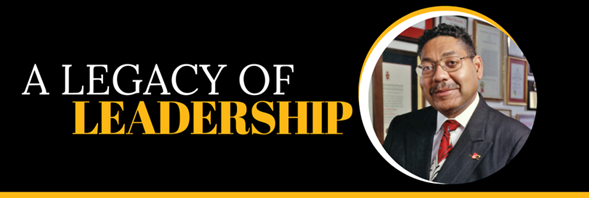
In Indianapolis, Bill Mays is widely known for the national success of his company, Mays Chemical. But those who worked alongside him and benefited from his leadership remember something more deliberate at work: business was never an end in itself. It was the means by which he created the capacity to give, invest, and strengthen institutions that could serve the community long after any single contribution was made.
For his wife, Dr. Rose Mays, that philosophy was simply how Bill moved through the world.
“If you were in a position to give, then you should be giving,” she said. “That was just how he lived.”
That belief shaped not only where the Mays family invested their resources, but how Bill approached leadership, philanthropy, and partnerships with nonprofit organizations across the city. It is also what made his involvement with The 100 Black Men of Indianapolis both natural and deeply aligned with his values.
A Worldview Rooted in Preparation and Perspective
Rose first met Bill as a child in church in Evansville, Indiana. Even then, she recalls, he stood out for his discipline and approach to complex issues.
She remembers a youth debate in the 1960s, when students were asked to argue whether China should be admitted to the United Nations. While many framed the discussion in terms of Cold War politics, Bill focused on the humanitarian consequences and the global responsibility to address hunger and poverty.
“He had done the research,” Rose said. “But he was also thinking about the people who were affected. He always looked beyond the surface and analyzed the impact on people.”
That broader perspective was reinforced at home. Bill’s father was a chemistry teacher who earned advanced degrees at a time when many universities did not admit Black students. The family temporarily relocated so his father could continue his education.
“Education was always the pathway forward,” Rose said. “He understood what access meant, especially for Black families, because he had seen what it took for his own family to get it.”
Those experiences shaped Bill’s expectations of himself, and later, how he defined responsibility once he had achieved professional success.
Business as Infrastructure for Community Investment
Bill Mays built his company with the same discipline he applied to everything else. But he did not see business success as a matter of personal achievement alone.
“He used to say, ‘If I don’t go to work and make money, I can’t give it away,’” Rose recalled.
Growth was not simply about scale; it was about capacity. Capacity to support educational institutions, nonprofit partners, and initiatives that addressed long-term community needs.
Even after transferring day-to-day leadership of the company to their daughter, Kristin Mays-Corbitt, in 2011, Bill remained actively engaged—not in operations, but in what came next.
“He knew the company was in strong hands,” Rose said. “That gave him the freedom to focus on mentoring other entrepreneurs, supporting community organizations, and helping leaders transform promising ideas into sustainable ventures.”
To Bill, economic development and social progress were interconnected. Strong businesses created jobs and stability, but they also created the financial foundation needed to reinvest in people and institutions.
Moving Beyond Transactions: The Endowment Model
One of Bill’s most significant, and less visible, contributions to community organizations was his emphasis on financial structure.
Through his work with the Kappa Alpha Psi Foundation and service on boards including the Indiana University Foundation, Bill developed a deep understanding of how philanthropic systems function and where they often fail.
“He understood the back side of philanthropy,” Rose said. “Not just the giving, but how you build something that can keep operating.”
That knowledge shaped his approach to supporting The 100 Black Men of Indianapolis. Rather than focusing solely on annual contributions, Bill supported the creation of an endowment to generate ongoing funding for mentorship and education programs, ensuring access for future generations.
The goal was not simply to fund current programming, but to reduce long-term financial volatility and allow the organization to plan for growth.
At a time when much charitable giving was tied to short-term fundraising cycles, Bill was investing in institutional stability by helping position nonprofit organizations as long-term partners in community development rather than recipients of episodic support.
Values That Mirror the Mission of The 100
Bill’s priorities closely align with The 100 Black Men of Indianapolis’ mission today, particularly in education, financial literacy, and lifelong mentorship.
“Bill was always talking about saving, investing, and learning how to manage money,” Rose said. “He believed that if young people understood how to build financial stability early on, it could change the entire course of their lives.
To Bill, financial literacy was about more than budgeting. He understood financial literacy as a tool for achieving agency, resilience, and the ability to make long-term decisions from a position of strength.
These principles are embedded in The 100’s programming model, which combines academic support with leadership development and real-world preparation—reinforcing Bill’s belief that mentorship must address both opportunity and infrastructure.
A Legacy That Continues to Shape Institutions
Bill’s influence continues through initiatives that extend far beyond his lifetime.
Through the leadership of family friend and philanthropist Lacy Johnson, the Mays Family Institute on Diverse Philanthropy was established in Bill’s honor at Indiana University’s Lilly Family School of Philanthropy. The Institute focuses on research and education on philanthropy in communities of color, an area that has been historically underrepresented in formal philanthropic studies.
“People hear the word philanthropy and tend to think of the same few names and institutions,” Rose said. “But communities of color have always been giving—not just money, but time, leadership, and care. This Institute helps recognize that history and make sure it’s studied, valued, preserved, and supported.”
Within the Mays family, Bill’s voice still guides decisions. When difficult questions arise, Rose and Kristen often pause and ask: What would Bill do?
“Usually the answer is to take the higher road,” Rose said. “To be generous. To be patient.”
And across Indianapolis, his influence continues through organizations like The 100 Black Men of Indianapolis, where mentorship, education, and leadership development remain central to building stronger futures for young men.
Paying It Forward as a Way of Life
If Bill Mays were offering guidance to today’s mentors and supporters of The 100, Rose believes his message would be clear:.
Set goals.
Set ambitious goals.
Be disciplined.
Strive for excellence.
And understand that success carries responsibility. Those practices helped shape how Bill built his business, structured his philanthropy, and invested in people. And it is why his legacy is not measured only in dollars or buildings, but in systems, institutions, and young lives that continue to benefit from his long view of what community investment s