
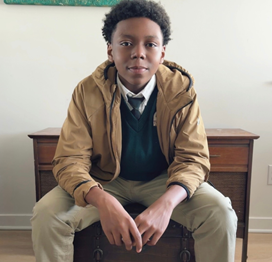
When Jalaina Moore enrolled her son in the 100 Black Men of Indianapolis’ Team Mentoring program, she wasn’t thinking about extracurricular activities or résumé builders. She was thinking about legacy—his, and hers.
From a young age, Jalaina understood that her son would need guidance that extended beyond what she could provide on her own. She could teach him values, support his education, and advocate for his future, but she knew he would face experiences, expectations, and realities that required mentorship from men who had walked that path themselves.
“I ached for him to have strong, positive Black male role models in his life,” she said.
That yearning led her to the Team Mentoring Program, where her son, Ali, began attending weekly sessions as a fifth grader. What started as a structured commitment—Saturday mornings filled with lessons, discussions, and activities—gradually became something more foundational. Each session began the same way: breakfast shared among mentors and mentees, followed by lessons on habits, discipline, and the character traits necessary to navigate adulthood with integrity.
“We learn about habits, like self-control, discipline, and integrity, and the kind of character you need to grow,” Ali said. “It helps you think differently about who you want to become.”
At first, the meaning behind those lessons wasn’t always obvious to him. Like many young people, he didn’t immediately recognize the long-term significance of sacrificing his Saturdays. But mentorship is rarely defined by a single breakthrough moment. Its impact accumulates quietly over time through repetition, consistency, and the steady presence of people who expect more from you.
Jalaina began to notice the changes before her son could fully articulate them himself. Ali had always been independent and inward-focused, someone who didn’t naturally seek out affirmation from others. Through Team Mentoring, he was placed in an environment where expectations were clear, and encouragement was intentional. Mentors recognized his progress, held him accountable, and praised his achievements, which strengthened his confidence.
“He’s gained a lot of confidence,” Jalaina said. “And his self-discipline has improved.”
That growth became evident in subtle yet meaningful ways. Ali became more attentive, more aware of his surroundings, and more thoughtful in his decisions. He carried himself with a greater sense of purpose, shaped not only by what he was being taught but by the men who were investing in his future.
Mentors like Mr. Hailey, Mr. Kinchen, and Mr. Pittman became important figures in his life—not simply instructors, but examples of what leadership, accountability, and care could look like in practice.
“Mr. Pittman has always been there,” Ali said. “He’s funny, he’s caring, and he supports everybody.”
For Jalaina, those relationships represented something deeper than mentorship. They reflected a level of investment that extended beyond the program itself.
“Mr. Hailey has such a love for the boys,” she said. “He stands in the gap for them.”
Through those connections, Ali gained access to opportunities that broadened his understanding of what was possible. He traveled to New Orleans to attend The National 100 Black Men Conference, where he encountered peers and professionals from across the country who shared their experiences and career paths. He participated in STEM sessions that introduced him to coding and application development, exposing him to technical skills that could shape his academic and professional future.
“I get to program an app,” he said. “I never thought we would do that here.”
For Jalaina, these experiences affirmed the importance of her decision to seek mentorship. She understood that exposure to new environments, expectations, and possibilities was essential to helping her son envision a future beyond his immediate surroundings.
“He’s gaining access to skills, mentorship, and opportunities that have changed his trajectory,” she said. “That kind of investment plants seeds that impact generations to come.”
But beyond the technical skills and travel experiences, the most significant impact was internal. Mentorship helped shape Ali’s sense of identity and responsibility, reinforcing values that would guide him long after the program itself ended.
Jalaina had always believed her son was capable of creating something different—not only for himself, but for the generations that would follow him.
“I’ve put a big responsibility on his shoulders,” she said. “To create a new type of man for this bloodline and pass that down.”
The 100 did not replace her role as his mother. Instead, they strengthened the foundation she had already built, surrounding him with mentors who reinforced those expectations and helped him see them reflected in real, tangible examples.
Today, Ali continues to grow through the program, developing skills, building relationships, and deepening his understanding of himself. He may not yet fully grasp the long-term significance of these experiences, but he recognizes their value.
“If I stopped doing this,” he said, “I’d miss out on a lot.”
For Jalaina, the impact is already clear. She sees it not just in what her son has accomplished, but in who he is becoming—a young man shaped by discipline, guided by mentorship, and supported by a community committed to his success.
Through the Team Mentoring Program, mentorship has become more than a weekly commitment. It has become part of the framework shaping his future, and, in doing so, helping redefine what is possible for their family.