
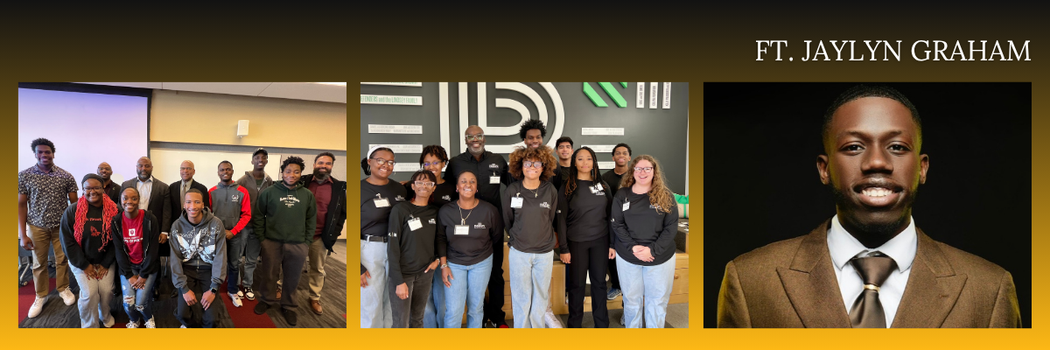
 At some point, the young people we mentor transform into leaders. For The 100 Black Men of Indianapolis, that transition is increasingly taking place on college campuses.
Through partnerships with Ball State University and IU Indianapolis, The 100 supports Collegiate 100 chapters that put college students in charge of building organizations around the needs they see in themselves, on their campuses and in their communities.
The connection to The 100 matters. Students gain access to mentors, professional relationships, and a network that stretches well beyond campus. But Collegiate 100 is not about adults prescribing what leadership should look like for the next generation. Instead, the program empowers emerging leaders to identify the needs they want to address, shape their own approach to professional development and service, and ultimately learn what happens when an idea becomes their responsibility to carry forward.
Jaylyn Graham sees that process up close as an adviser to Ball State’s Collegiate 100 chapter.
“Collegiate 100 gives students the chance to decide what leadership looks like for them,” Graham said. “They’re identifying the professional development they need, building the relationships that will help them grow, and deciding how they want to make an impact. We’re there to support them, but they’re the ones learning how to lead.”
A student proposes an idea, brings it to a meeting, and suddenly has to figure out what it will take to make it happen. Who needs to be involved? What happens when the first plan falls apart? How do you bring people with you, adjust, and keep moving?
Those moments give students something a classroom cannot always replicate: the experience of being responsible for an outcome. And sometimes, only after being handed that responsibility do they begin to recognize what they are capable of.
“This is the time to discover yourself as a leader, discover yourself as a person, and determine what your strengths and weaknesses are,” Graham said, and he was speaking from experience.
Graham did not discover his own capacity for leadership because someone told him it was there. He discovered it when college put him in situations that required him to use it.
Close Enough to See Yourself There
Graham arrived at Ball State in 2017 from Nashville, where he had participated in a high school senior program offered by The 100 Black Men of Middle Tennessee. At the time, Ball State did not have a Collegiate 100 chapter, so leaving Tennessee also meant leaving behind his formal connection to the organization.
College, however, introduced Graham to a different set of influences. He was introverted, and although his mother had long told him she saw leadership qualities in him, Graham had yet to recognize them himself. That began to change as he took on responsibilities that pushed him beyond his comfort zone.
“I was put in these uncomfortable spaces and had to lead things, and that’s where I really was able to see myself shine,” he said.
Some of the people who helped shape that growth were not much older than Graham. As a freshman, he looked to upperclassmen who were already navigating the experiences still ahead of him. Because he knew them personally, he could observe how they led, ask questions about the decisions they were making, and begin to imagine his own path forward. And their influence stayed with him.
Today, at 27, Graham has earned undergraduate and graduate degrees from Ball State, built a career in technical consulting, and returned to his alma mater as a Collegiate 100 adviser. In many ways, he now occupies the position those older students once held for him: far enough along to offer perspective, but close enough to the college experience that students can readily see themselves in his journey.
“I think having mentors is important,” Graham said. “I also think having older mentors, those who are not too far removed from where you’re trying to go, is equally important.”
Graham describes that role as being a “tangible source of visibility.” Students do not have to look decades into the future to imagine what progress might look like. They can build a relationship with someone who has recently navigated many of the same decisions they are making now and begin to see their own next steps more clearly.
A Network Students Can Put to Work
Collegiate 100 adds another layer to that visibility.
A student at Ball State or IU Indianapolis is not limited to the people he or she happens to meet in a classroom, student organization, or internship. Behind the collegiate chapter is a network of 100 Black Men members with careers, relationships, and experiences that students can begin tapping into as they figure out where they want to go. At Ball State, Graham sees both the potential and the challenge.
Indianapolis and Muncie are separated by more than geography. A network can exist on paper without ever becoming meaningful to a student on campus. Someone has to make the introduction. Someone has to explain who is in the room and why that relationship might matter. And students have to learn to step forward and use it.
“The network is there, but access only matters if students know how to use it,” Graham said. “Our role is to help make those connections real – to introduce students to the people and opportunities around them, and then empower them to build those relationships for themselves.”
The word empowered is important. The goal isn’t to hand students a list of contacts and call it mentorship. It is to help them become comfortable building relationships of their own: asking questions, seeking advice, following up, and eventually becoming someone who can open a door for another person. That is where Collegiate 100 begins to feel like more than a college experience.
From Being Invested In to Investing in Others
Graham eventually found his way back to The 100 after graduate school. He moved to Indianapolis and, shortly thereafter, reconnected with The 100 Black Men of Indianapolis. A brief conversation led to active volunteering, and within months, he showed up regularly and eventually became a member.
Three years later, he has worked with middle school students through the Team Mentoring program (a partnership between The 100 and Big Brothers Big Sisters of Central Indiana), helped students learn investment strategies through The Dollars & $ense Financial Literacy Program, and returned to Ball State to advise Collegiate 100. He has also stayed long enough to watch some young people move from one program to another.
That matters because the work of The 100 has never been about a single Saturday morning or one successful program year. The investment compounds. A middle school student gains confidence. A high school student begins thinking differently about their future. A college student starts building a network and taking responsibility for leading others.
Eventually, someone who benefited from that investment has something to give back. Graham is already living that progression: At 17, he knew The 100 as a student. At 27, students know him as a mentor.
And through Collegiate 100, 100 Black Men of Indianapolis and its university partners have an opportunity to help more young people make that transition intentionally. Not after they have established careers. Not someday when they feel like they finally have enough experience to give something back. Now.
College students are not simply future leaders waiting for their turn. They can organize, serve, mentor, build relationships, and influence their communities today while still having experienced people around them to help when they get it wrong. That combination is what makes the opportunity powerful.
The next 100 is already on campus. It’s up to us to invest in them now, connect them to opportunity, and give them every chance to lead what comes next.