
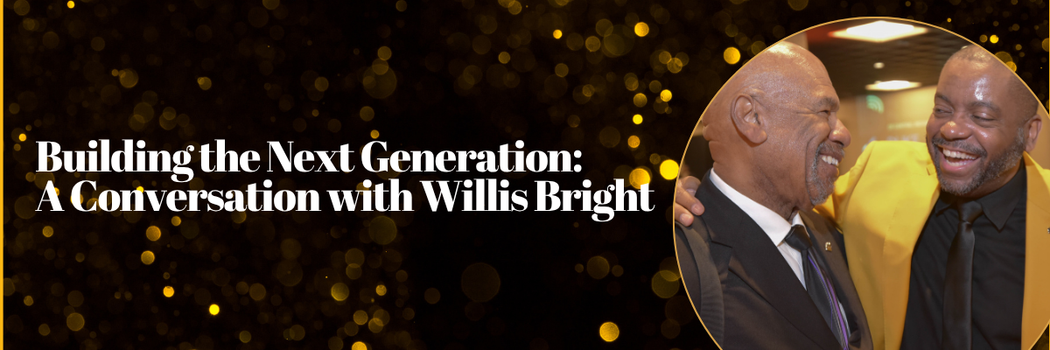
 At some point during The Beautillion Militaire Scholarship Program, Willis Bright wants the young men to get personal.
Who are you?
What do you want from your career?
What kinds of relationships do you want to build?
Where do you hope to be five or 10 years from now?
They are big questions to put in front of a high school senior, and Bright knows that. He isn’t looking for a perfectly mapped-out future. He wants young men to begin thinking seriously about the lives they will soon be responsible for building.
Years ago, Bright began gathering those questions into what became “My Man Plan”, a life-planning tool he created for participants in the 100 Black Men of Indianapolis’ Beautillion Militaire Scholarship Program.
“I wanted to create an organized way to engage young men in thinking critically about their lives,” Bright said. “I wanted them to be able to communicate those aspirations to their parents and to the other people who matter in their lives.”
He has been tinkering with it ever since.
As the world facing young people has changed, so has the plan. Bright regularly revisits the questions and considers what might be missing. In recent years, he added a section on habits, encouraging participants to look beyond what they want to accomplish and think about whether the choices they make every day will actually help them get there.
Near the end of the program, the young men take what they’ve been working through privately and share it with their parents and other important adults in their lives.
Bright has watched those presentations change considerably over the years. Today’s participants bring PowerPoints, videos, and a technological fluency that earlier classes didn’t have. But technology isn’t what has kept My Man Plan relevant. The conversation has.
For perhaps the first time, a parent may hear his or her son lay out, in one place, what he believes about himself, what matters to him and what he wants his life to become.
“It provides the parents an opportunity to hear, in a very organized way, what it is their sons are proposing to do with their lives,” Bright said.
Some of those young men hold onto their plans. Bright has heard from former participants who returned to them years later, when the five- or 10-year future they had written about at 17 was no longer so far away.
What began with Bright sitting down and writing a series of questions has become a permanent part of Beautillion. In many ways, My Man Plan captures the philosophy that has guided his life: Give young people the tools to imagine more for themselves, surround them with adults who care what happens next, and help create the conditions that give them a real chance to get there.
Raising Adults Ready for the World
Bright has his own version of the familiar saying about raising children.
“I have often said that I disagree with the notion that it takes a village to raise a child,” he said. “I counter and say it takes a village to raise a responsible adult.”
It’s a distinction he has thought about for years.
Of course children need love, security and support. Bright’s point is that adults’ responsibility doesn’t end there. Young people also need academic preparation, social and emotional skills, sound judgment and people who expect something of them. Eventually, they will be the ones raising families, leading workplaces and making decisions for their communities.
“Our goal has to be to equip them to be better adults than we were in our lives,” Bright said, “and to be able to deal with a world that is different from the world we grew up with.”
Bright carried that lesson into social work, philanthropy, and community leadership. Eventually, it also led him to the 100 Black Men of Indianapolis.
A Leader Always Recruiting
Bright has been around The 100 long enough that remembering precisely how he joined requires, as he puts it, a trip into his “memory bank.” But he does remember one influence clearly: Moses Gray.
Gray, a founding member of the Indianapolis chapter, was already part of Bright’s life. Their wives were close friends, and Gray apparently wasn’t the type to let a good prospective member remain merely a family friend.
“Anywhere that Moses was, he was an advocate for and a recruiter for the 100 Black Men,” Bright recalled.
If you spent enough time around Moses Gray, in other words, chances were good that The 100 was going to come up. But Bright didn’t need much persuading.
A social worker by training, he had already built his professional life around young people. What interested him about The 100 was the opportunity to make that work personal – to put Black boys and young men in regular contact with Black men who had careers, families and responsibilities of their own, and who were willing to be honest about what they had learned.
“What particularly captivated me is that it was a conscious effort to begin preparing young men to think about their future,” Bright said, “to put them in contact with adult men in the community who were themselves achievers in their workplace and their families.”
Bright gravitated toward The Beautillion Militaire Scholarship Program, and his oldest son would eventually participate in the program himself. Over the years, The Beautillion became the place where much of Bright’s professional understanding of youth development met his personal commitment to mentorship.
Investing in an Entire City
Bright’s belief in young people has never stopped at mentorship. His career has also focused on the neighborhoods, institutions, and opportunities that shape what becomes possible for them.
For roughly 25 years at Lilly Endowment, Bright worked at the intersection of philanthropy and youth development, eventually serving as director of youth programs. The position gave him a panoramic view of Indianapolis: which organizations were reaching young people, where communities were falling short, and what could happen when promising work had the resources to grow.
Even after retirement, Bright wasn’t finished.
He later became co-director of the Indianapolis African American Quality of Life Initiative, helping lead one of the most significant philanthropic investments in Black Indianapolis in recent history. Launched with a $100 million grant from Lilly Endowment, the initiative put substantial resources behind ideas generated within the community itself, supporting work in education, housing, health and wellness, employment, entrepreneurship and other areas that determine whether families and neighborhoods can thrive.
The size of the investment is striking. The thinking behind it is equally important.
A scholarship can help a student afford college, but whether that student reaches college begins much earlier. A mentor can encourage a teenager to imagine a bigger future, but that future is also shaped by the school he attends, the stability of his home, the health of his family, the opportunities in his neighborhood, and whether someone opens a door when he is ready to walk through it.
Bright has spent his career working in those intersections.
It is what connects a $100 million investment in Black Indianapolis to a young man sitting down with My Man Plan. One works to expand what is possible around him; the other asks him what he intends to do with that possibility.
The Return on an Investment
For all the ways Bright has spent his career measuring impact – dollars invested, organizations strengthened, programs expanded – some of the returns have found him in unexpected places.
At the gym, a man approached Bright and reintroduced himself as a former Beautillion participant. Years earlier, Bright had known him as a high school student preparing for whatever came next. Now he had graduated from college, started his career, and was building the adult life that Beautillion had once asked him to imagine. They stood there and caught up.
Bright has also had parents stop him, sometimes years after their sons completed the program, to thank him for the time he and other members of The 100 invested in their families.
“Those are the kinds of things that make an organization – and those of us who are in the organization – feel like we are making a difference and improving the quality of life in our community,” Bright said.
After decades with The 100, Bright has also watched mentorship begin to reproduce itself.
He jokingly calls himself one of the organization’s “graybeards.” His role today extends beyond the young men in Beautillion to younger members of The 100 who are building careers, raising families, and growing into community leaders themselves.
“To be a graybeard that has not only been able to contribute to the way we approach our young people, but to also be a support to the other members,” Bright said, “that has also been a wonderful thing!”
That may be one of the clearest measures of Bright’s impact. The work doesn’t stop with the person directly in front of you. A young man becomes an adult. A younger member becomes a seasoned mentor. Someone who once benefited from another person’s investment eventually has something of his own to give. Willis Bright has been fortunate enough to see some of that impact walk back up to him. Most of it, he never will – and perhaps that’s what it really means to leave a place better for having been there.